SCUM MANIFESTO contexts 21
Lefebvre), and Les Cent Fleurs (Danielle Jaeggi and JeanPaul Fargi-er) — video groups appeared, echoing the MLF (the Women’s Lib-eration Movement in France), which were non-mixed, short-lived and varying. These include: Vidéa in 1974 (Syn Guérin, Catherine Lahourcade, Anne-Marie Faure), Les Muses s’amusent (that trans-lates as “The muses are having fun”) in 1975 (Delphine Seyrig, Ioa-na Wieder, Monique Duriez, Claude Lefèvre-Jourde — following a video workshop organised by Carole Roussopoulos). Shortly after, Carole Roussopoulos, Delphine Seyrig and Ioana Wieder created Les Insoumuses. These three women founded the Centre audiovis-uel Simone de Beauvoir (Simone de Beauvoir audiovisual Centre) in 1982.
These video collectives significantly contributed to the popu-larisation of the feminist movement. They highlighted specific ac-tions (protests, strikes, occupations) and dealt with new subjects, which were dismissed by the dominant media (sexuality, lesbi-anism, prostitution, motherhood, children’s education, domestic work, self-help). Video became another means of expression and mobilisation, along with leaflets, banners, slogans and songs, there-
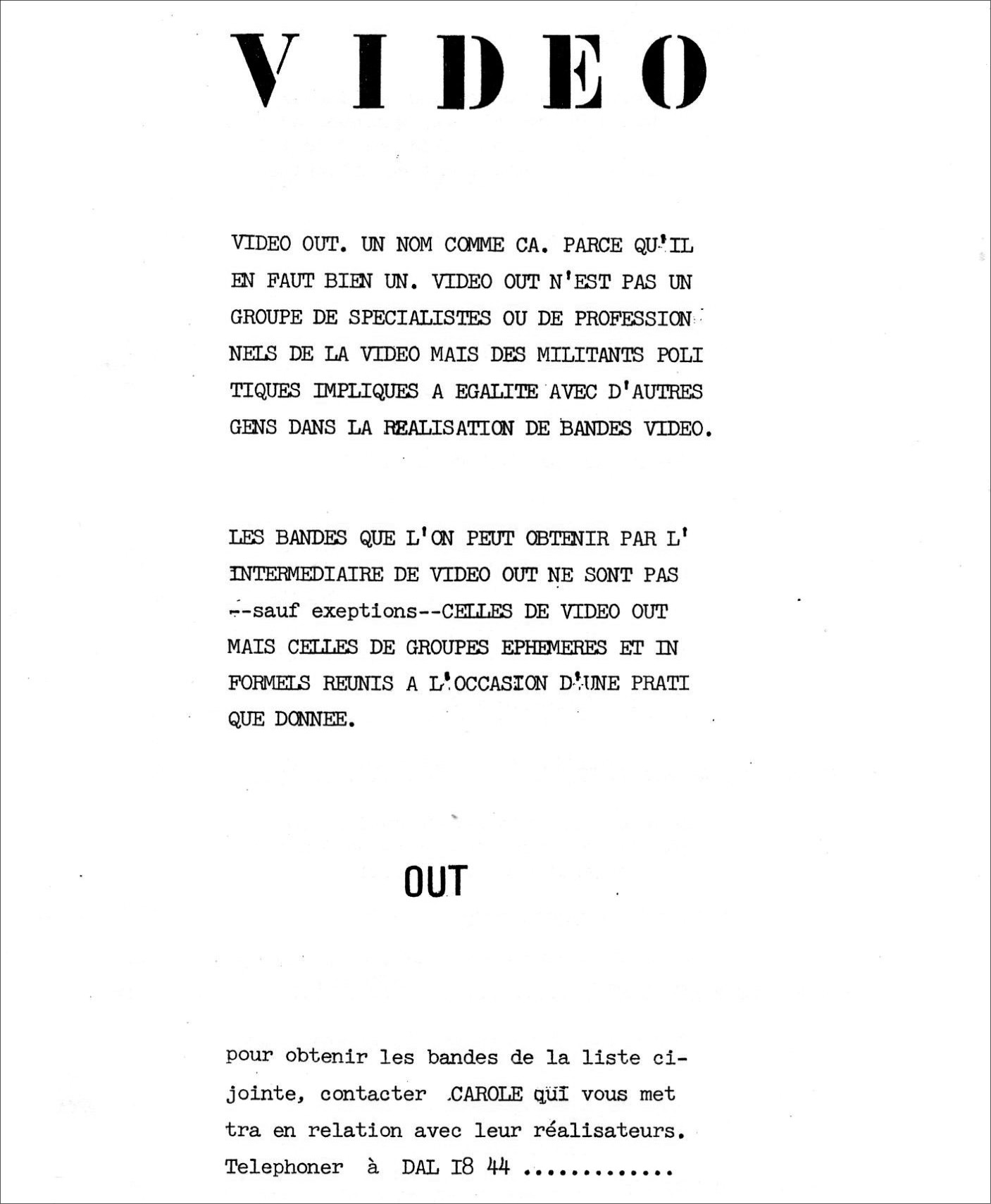
Vidéo Out, in Vidéo-info, January 1973.