SCUM MANIFESTO contexts 42
against Valerie Solanas in particular. Coming from a working-class background, brought up by an abusive alcoholic grandfather, who abandoned her when she was 15, Solanas became homeless, engag-ing in sex work in order to survive and fund her studies. Solanas’s words are shaped by her individual trajectory, which is inextrica-bly linked to the structural violence of imperialist, capitalist, white supremacist, patriarchy…the list of intersecting systems of domi-nation is long. To quote the feminist Ann Cvetkovich, “[W]e are a sensitive interface with the world”, our bodies are “shaped by his-tories of violence”, they “[carry] historical residues, collective res-idues” of racism, sexism, and homophobia. SCUM Manifesto thus constitutes “an archive of feelings” 12 (anger, outrage, desire, hope), mobilised for a project that is both utopian and nihilistic: escaping this scumful existence in order to imagine something else, a world that would be exclusively feminine and driven by love.
12 Ann Cvetkovich, An archive of feeling : Trauma, Sexuality, and Lesbian Public Cultures, Durham, Duke University Press, 2003
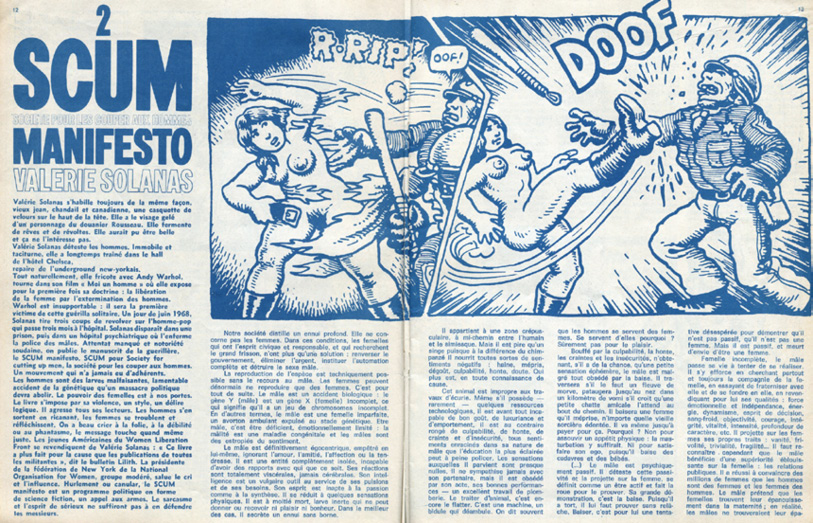
First extracts of SCUM Manifesto published in France in January 1971 in Actuel accompanied with illustrations by Robert Crumb. The first French edition completed the same year in a translation by Emmanuèle de Lesseps. The 4th issue of Actuel, “nouvelle série (new series)”, January 1971.