
1900 Plank
Energy quantification
At the microscopic level, a system’s energy is gener-ally quantized, meaning it cannot take just any value but only certain discrete values called energy lev-els, which are determined
by quantum physics. This also implies that energy exchanges between mat-ter and light occur in discrete packets, called quanta.
1905 Einstein
Light: energy waves and quanta
Einstein went further, proposing that these quantum properties are inherent to light itself, which he suggested was
made up of particles, later called photons.
It has since been observed that light behaves both as a wave and as a particle.
1924 Louis De Broglie
Matter: wave-particle duality
Beyond light, this wave-particle duality also applies to matter: under the right laboratory con-ditions, a particle such as an electron is no longer
considered a point but rather a wave spread out over a small region of space. In this state, the particle exists in multiple locations simultaneously.
1926 Max Born
Probability wave
This wave is mathemat-ically described by a quantity called the wave function, introduced by Schrödinger. Born demonstrated that the wave function provides
the probability of find-ing the particle at a given location and allows pre-dictions about what can be measured in the laboratory.
These discoveries led to the definition of several major quantum mechanical postulates
Superposition principle
An electron (or any other particle) can exist in a superposition of posi-tions. This principle applies to any observable quantity, such as speed or energy. The wave
function represents this superposition and assigns a probability to each posi-tion around the nucleus where the particle may be measured.
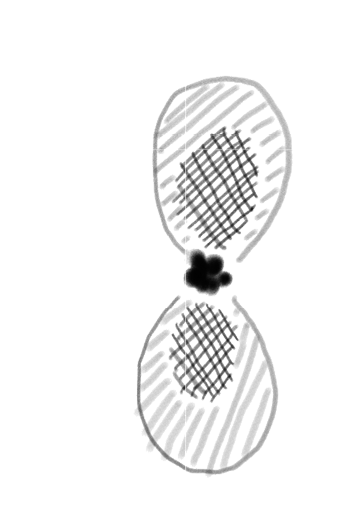
Two different wave functions: each represents a superposition of positions for an electron around the nucleus. The darker the color, the higher the probability.
Measurement
At the moment of mea-surement, the particle is always observed at a sin-gle point. The act of mea-surement thus destroys the superposition state (or wave-like nature) of the observed particle. This phenomenon is known as wave function collapse.
Quantum reconstruction
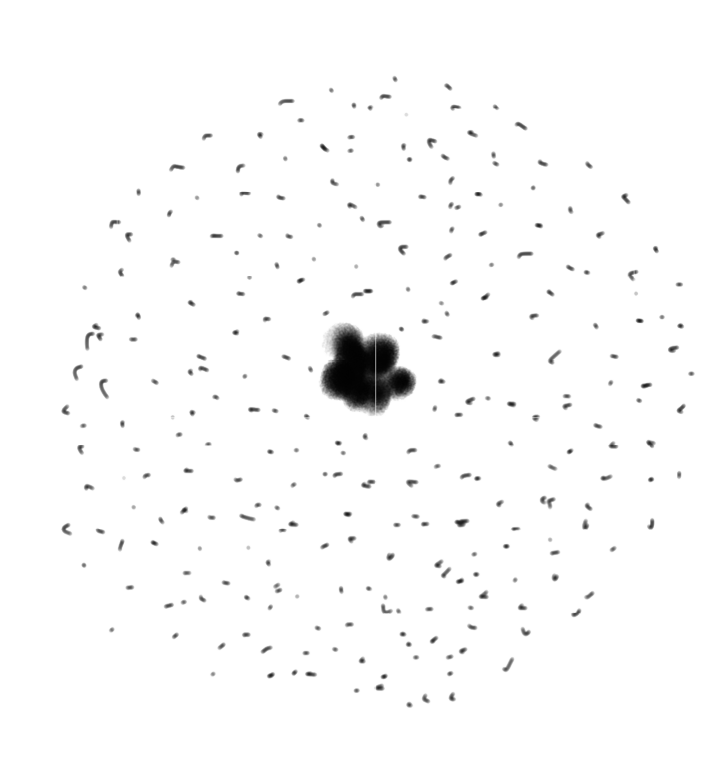
The wave function can be reconstructed through a series of experimen-tal measurements. To achieve this, a large num-ber of measurements must be conducted to determine the probability of detecting the particle at each point.
History & concepts

1st measurement
2nd measurement
3d measurement
10 000 measurements